Same alerts.Same pressure.You'll read them differently.
Beginners see too many alerts and no structure. Analysts see patterns. SOCWAVE is the practice that moves you from one to the other: realistic scenarios, real tools, and scoring that holds every run to the same standard, so you finish able to prove it.
- Start free
- No card required
- Add paid packages anytime
- Alert triage
- Log analysis
- Containment decisions
- Threat hunting
- Memory forensics
- Cloud IAM investigation
- Stakeholder comms
- Timeline reconstruction
- Email analysis
- Hypothesis-driven hunts
- Crisis decision-making
- ATT&CK mapping
The readiness gap
Knowing the theory is not the same as surviving the incident.
The queue never stops.
Event after event, and nearly all of it is noise. Real incidents don't announce themselves; they arrive in the same stream as everything else.
Five lines matter.
Theory tells you what each one means. It doesn't tell you which to see first, or that together they're one attacker heading for your backups.
You have one decision window.
What do you do first? Make the call. On SOCWAVE this moment is a training, so when it happens for real, it won't be your first time.
SIEMLIVE QUEUE
1 INCIDENT
- 02:03idpimpossible travel: svc_backupLOW
- 02:09adnew member added to Domain AdminsMEDIUM
- 02:14edrfile share enumeration from WS-FIN-112MEDIUM
- 02:17ad3 more hosts authenticating as svc_backupHIGH
- 02:19edrshadow copies deleted on FILESRV-01CRITICAL
What do you do first?
The platform
This is the console you'll train in.
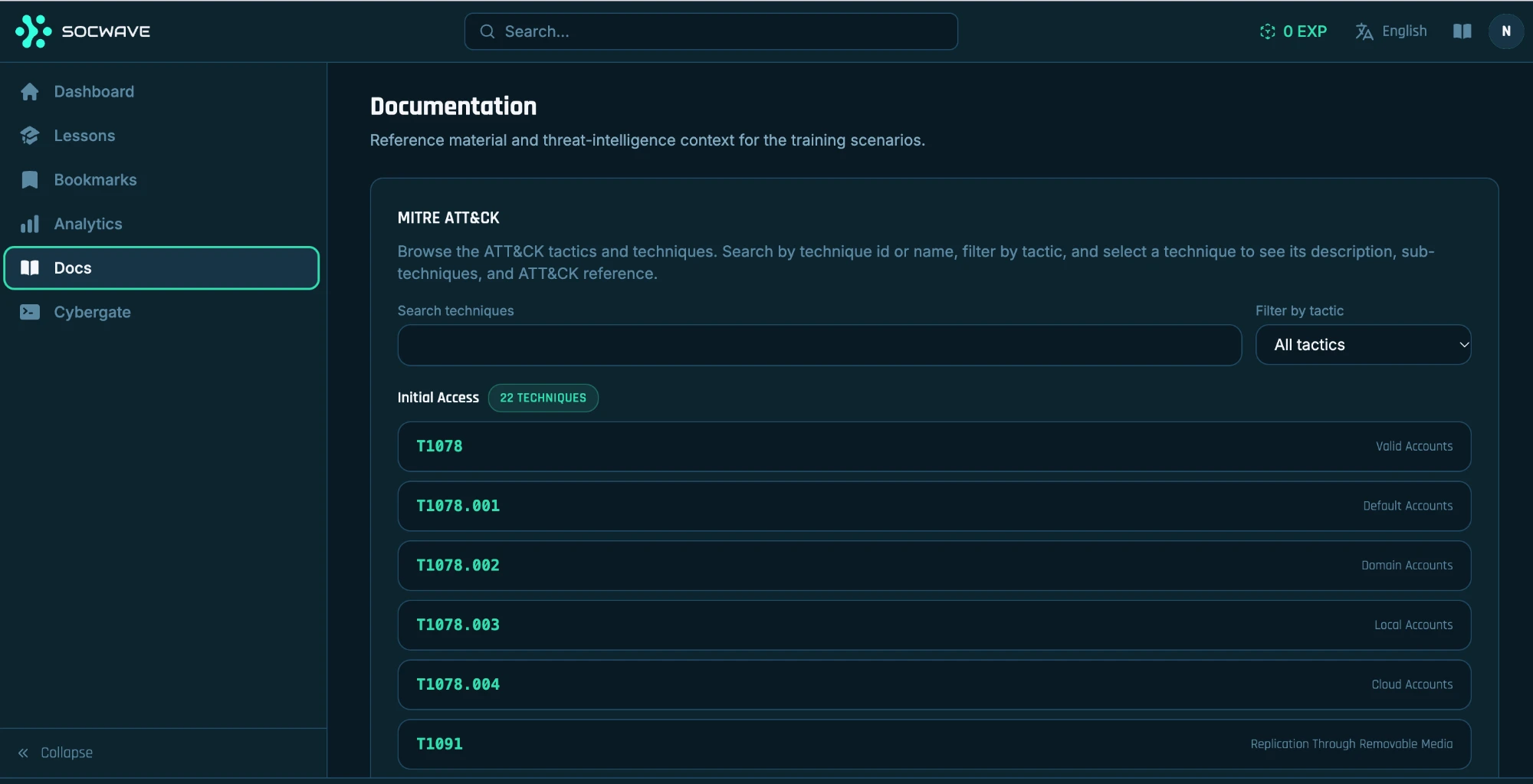
Not a concept render. These are the platform's working surfaces: your learning path, a live scenario in the SOC Simulator, and the progress record that follows you across your career.
Lessons
Structured lessons you work through at your own pace, next to the hands-on labs.
MITRE ATT&CK, built in
Search techniques by ID or name and filter by tactic, without leaving the console.
Analytics
Progress tracking and skill coverage: what you've covered, and what's still dark.
EXP on every run
Experience points build up as you train, into a progress record you can show.
How it works
One scenario, start to finish: the way you'll actually live it.
- 01
Curiosity
Receive your briefing
Every training opens like a real case: a situation report, the environment you're stepping into, and what's at stake.
- 02
Discovery
Investigate the environment
Work hands-on through logs, alerts, and systems modeled on real incidents, at your own pace.
- 03
Stress
Make the calls under pressure
The scenario escalates the way incidents do. Contain, escalate, keep watching: it's safe to be wrong here.
- 04
Insight
Debrief like a mentor would
A structured debrief walks your decisions back: what the signals meant, and what the alternatives were.
- 05
Confidence
Build your record
Every run is scored, so progress is a record you can show. The next scenario starts a step harder.
Why trust SOCWAVE
Credibility you can verify by training.
Expertise
Built by practitioners
Every scenario is authored by veterans who have run real incidents. The details, dead ends, and pressure come from operational experience, not textbooks.
Realism
Real tools, real signals
You train against realistic environments and genuine tooling patterns, so what you practice transfers to the console you'll sit at.
Method
Mentored, not just measured
Structured debriefs walk your decisions back with you. The platform behaves like an expert mentor, not a grader.
Scoring
Proof, not participation
Every run is scored deterministically. The same scenario holds every learner to the same standard, so your result means something outside the platform too.
Built for
Students & learners
From university coursework to your first analyst seat
Working analysts
Continuous upskilling that fits around on-call life
Teams & institutions
A shared training ground for cyber resilience
Educators & universities
Scenario work your cohorts can run as coursework
A starter learning path (SOC Foundations), a rotating selection of open scenarios, EXP and progress tracking, and a full debrief after every run. No card needed.
When you want more, you pick the package of labs and lessons that fits what you're training for, and pay for that package. You add packages when you're ready, not before.
Soon. Join the waitlist and we'll email you the moment the platform opens.
Get early accessAnyone on the cybersecurity capability ladder: students building their first practical skills, working analysts who want to keep their judgment sharp, and security teams or institutions training their people. The scenarios scale in difficulty, so the platform grows with you.
SOCWAVE is built around doing, not watching. You investigate realistic incidents, make decisions under pressure, and get a mentor-style debrief on your reasoning. Courses give you knowledge; SOCWAVE turns it into judgment you can rely on when it counts.
Your pace is the point. Scenarios pause where you leave them and resume where you stopped, with no artificial deadlines. Progress, EXP and skill coverage simply accumulate as you train.
The alerts won't get quieter.
You'll get better at reading them.
Open your first scenario on the free package, no card needed. When you want more, pick the package of labs and lessons that fits you.
- Start free
- No card required
- Add paid packages anytime